
LA MIGRATION IRRÉGULIÈRE ET DE TRANSIT AU MALI : DE L’ESPOIR AU DÉSESPOIR
Date de Publication : septembre 2014 | RGO 0 Volume 0 | Page No.:51-66
ISSN : 0796-9694
Télécharger PDF
RESUME: L’émigration irrégulière ou franchissement des frontières sans autorisation, est un phénomène relativement ancien. La présente étude analyse les caractéristiques sociodémographiques des migrants, les principaux déterminants de la migration irrégulière tout en éclairant le rôle des différents acteurs impliqués. Elle identifie les itinéraires, les obstacles au déplacement et les perceptions des migrants.
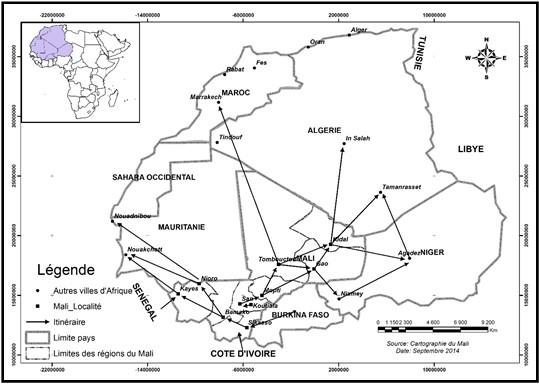
Les enquêtes par collecte de données secondaires, par questionnaire et entretiens, sont menées auprès d’un échantillon de 50 migrants, trois ONG, quatre services de la Police Nationale et deux du Ministère de la Justice. En termes de résultats, 34,2% des migrants résident au Mali au cours des quatre dernières années et sont majoritairement des hommes (78%). Ce sont d’abord des ressortissants ouest-africains (Nigérians (28%), Libériens (4%), Guinéens (4%), Ivoiriens et Ghanéens (respectivement 2% ). Les Africains du Centre sont fortement représentés par les Camerounais (20%) et les autres du Bassin du Congo, très faiblement. Les itinéraires Gao-Algérie-Maroc et Kidal-Algérie-Maroc conduisent les migrants en Espagne ; les couloirs migratoires Gao-Agadez (Niger) et Kidal-Libye, les orientent vers l’Italie. Lors du voyage, ils sont tous dans en situation de vulnérabilité. Ils souffrent de faim (17%) et de soif (14%), de fatigue (12%), de maladies (8%), de traumatismes psychologiques. Ils sont objet de maltraitance (11%), de spoliation (10%), d’arnaque (10%) et d’intolérance de la part des autorités des pays de transit et d’accueil. Malgré ces nombreux obstacles, le sentiment général est que l’arrêt de la migration irrégulière n’est pas pour demain.
Mots clés : Migrations, corruption, trafic, souffrances, Mali.
ABSTRACT:
The illegal and transit migration in Mali : from hope to despair
Irregular migration or cross the borders without authorization, is a relatively recent phenomenon. This study analyzes the demographic characteristics of migrants, the main determinants of irregular migration while highlighting the role of the various actors involved. It identifies routes, obstacles to movement and perceptions of migrants.
Investigations by collecting secondary data, questionnaire and interviews were conducted with a sample of 50 migrants, three NGOs, four services of the National Police and two from the Ministry of Justice. In terms of results, 34.2% of migrants residing there for the past four years and are predominantly male (78%). These are the first West Africans (Nigerians (28%), Liberians (4%), Guineans (4%), Ivoirians and Ghanaians (respectively 2%). Central Africans are strongly represented by Cameroon (20 %) and other Congo Basin, weakly. Routes Gao-Algeria-Morocco and Algeria-Morocco-Kidal lead migrants in Spain. Migratory corridors Gao, Agadez (Niger) and Kidal, Libya, refer them to the Italy. During the trip, they are all in situations of vulnerability. They suffer from hunger (17%) and thirst (14%), tiredness (12%), disease (8%), psychological trauma. They are being abused (11%), theft (10%), scam (10%) and intolerance of the authorities of the countries of transit and destination. Despite these many challenges, the overall feeling is that the judgment of irregular migration is not for tomorrow.
Key Words: Irregular migration, corruption, traffic, suffering, Mali..