
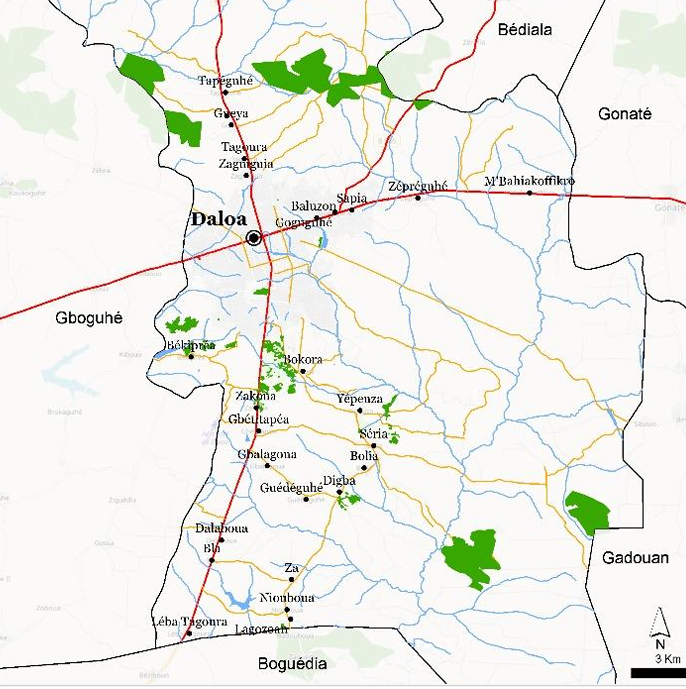
RESSOURCES ALLOCATIVES ET PRODUCTIONS AGRICOLES À ZOKOGUHÉ EN CÔTE D’IVOIRE
RESUME : L’agriculture est l’activité principale des populations de Zokoguhé. Constituée de cultures vivrières et de cultures d’exportation, elle est source de création de richesse et de revenu. L’efficacité et la pérennité de ces systèmes de production dépendent de la manière dont les ressources sont allouées et gérées par les exploitants agricoles. L’objectif de cet article est de connaitre les ressources allouées dans les productions agricoles vivrières et dans les productions pérennes à Zokoguhé en Côte d’Ivoire. Les données secondaires et primaires constituent le cadre méthodologique. Un échantillon de 97 chefs d’exploitation agricole a été questionné. Le dépouillement et l’analyse des données ont été faits manuellement, par Excel et par STATA 17 selon la nécessité pour une analyse statistique descriptive et bivariée. Il résulte de cette analyse que les terres louées (15%) sont exclusivement dédiées aux vivriers tandis que les autres (85%) sont allouées aussi bien aux vivriers qu’aux cultures pérennes. La proportion de la main-d’œuvre familiale dans la production des cultures pérennes est moins importante (35%) que celle dans la production vivrière (64%). Les engrais NPK 12-22-22, NPK14-18-18+6S+1B2O3 et l’Urée Perle 46%N sont utilisés pour les espaces dédiés aux cultures vivrières. Quant aux espaces des cultures pérennes, les engrais foliaires, l’engrais NPKSB 15-15-15+6S+1B, l’engrais Anhydride 23%+ Oxyde de Potassium 19% et l’Urée y sont employés. L’allocation de la ressource temporelle diffère beaucoup des productions pérennes aux productions annuelles. Ces dernières demandant plus de temps de travail du fait de la répétition du cycle de travail au moins deux fois dans l’année. À la suite de la présente étude, nous recommandons un programme de formation des producteurs en vue d’améliorer leur capacité de gestion, concomitante, des ressources de production pérennes et annuelles afin d’accroître les rendements.
Mots clés :Allocation des ressources, productions agricoles vivrières et de rente, Zokoguhé, Côte d’Ivoire
ABSTRACT
ALLOCATIVE RESOURCES AND AGRICULTURAL PRODUCTION IN ZOKOGUHE, COTE D’IVOIRE
Hotels are essential to the development of tourism in Côte d’Ivoire. Fortunately, the country has a large number of hotels. The San Pedro region, which is the country’s second-largest tourist region after Abidjan, has a large number of hotels. Most of them have put in place measures to combat the nuisance of culicidae. The aim of this study is to analyze the measures used in these hotels to combat culicid pests. The methodology adopted is quantitative. It is based on a questionnaire survey and the use of GPS to geo-locate the hotels. The results show that the town of San Pedro has 113 hotels with 1,619 rooms, including 1,229 air-conditioned rooms and 390 ventilated rooms for the year 2023. The devices used in hotels to combat mosquitoes are aerosol cans (67%), mosquito barriers (27%), insecticide-impregnated mosquito nets (3%) and smoke coils (1%). Despite the diversity of devices, aerosol cans remain the most widely used tool in the fight against culicidae. The results also show that the majority of hoteliers (57%) stick to a single type of insecticide. They use only the insecticide RAMBO®, or BAYGON®, or BOXER®… Others, however, alternate between two different types of insecticide (38%). Some hoteliers alternate three different types of insecticide (5%). It should be noted that impregnated mosquito nets and intra-domiciliary spraying are the means of control par excellence used by the Ivorian authorities against culicidae.
Agriculture is the main activity of the populations of Zokoguhé. Comprising both food crops and export crops, it is a source of wealth and income creation. The efficiency and sustainability of these production systems depend on how resources are allocated and managed by farmers. The aim of this article is to understand the resources allocated to food crop
production and perennial crop production in Zokoguhe, Cote d’Ivoire.
Secondary and primary data constitute the methodological framework. A sample of 97 farm operators was surveyed. The processing and analysis of the data were carried out manually, using Excel and STATA 17 as needed for descriptive and bivariate statistical analysis. It follows from this analysis that the leased land (15%) is exclusively dedicated to food crops, while the remaining (85%) is allocated to both food crops and perennial crops. The
proportion of family labor in the production of perennial crops is lower (35%) than that in the production of food crops (64%). NPK 12-22-22, NPK 14-18-18+6S+1B2O3 fertilizers, and Urea Pearl 46%N are used for areas dedicated to food crops. As for the areas of perennial crops, foliar fertilizers, NPKSB 15-15-15+6S+1B fertilizer, Anhydride 23% + Potassium Oxide 19% fertilizer, and Urea are applied. The allocation of time resources differs significantly between perennial and annual crop production, with the latter requiring more labor due to the repetition of the work cycle at least twice a year. Following this study, we recommend a training program
for producers to improve their capacity to manage both perennial and annual production resources in order to increase yields.
Key words: resource allocation, food crops, export crops, Zokoguhe, Côte d’Ivoire