

PERCEPTIONS POPULAIRES SUR LES ÉCORÇAGES ANARCHIQUES DU CAÏLCÉDRAT (KHAYA SENEGALENSIS) DANS LES ARTÈRES DE LA VILLE DE COTONOU
Date de Publication : octobre 2020 | RGO 0 Volume 1 | Page No.63-81:
ISSN : 0796-9694
Télécharger PDF
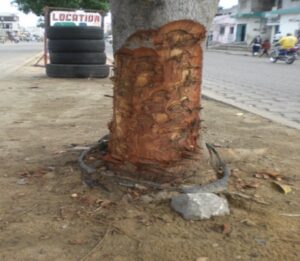
RESUME:L’utilisation du caïlcédrat (Khaya senegalensis) en reboisement urbain a commencé au Bénin depuis l’époque coloniale. Il a servi à boiser plusieurs axes routiers et places publiques. En sillonnant la ville de Cotonou qui constitue le secteur d’étude, on remarque en effet que la plupart des caïlcédrats utilisés comme arbres de reboisement urbain sont fréquemment écorcés et mutilés, ce qui compromet leur survie. Or c’est le maintien en vie des essences utilisées dans une action de reboisement qui garantit le succès de cette action. Cette recherche s’est fixée comme objectifs : (i) faire l’état des lieux de la situation actuelle de l’écorçage des caïlcédrats implantés dans les artères de Cotonou ; (ii) : ressortir la perception de la population de Cotonou sur l’écorçage du caïlcédrat dans les artères de cette ville ; (iii) : montrer comment l’écorçage participe à l’extinction du caïlcédrat. Recherche de nature quantitative et qualitative, elle a été menée sur un groupe cible de 44 personnes.
Les résultats montrent que les abords des artères et les terre-pleins centraux de plusieurs routes de la ville de Cotonou ont été boisés avec le caïlcédrat. Au total, 41 axes sont couverts avec 2089 pieds de caïlcédrats. Les raisons qui ont milité en sa faveur comme arbre de reboisement urbain sont entre autres son adaptation facile aux embruns marins, sa disponibilité en pépinière, son ombrage et sa capacité à garder le feuillage pendant longtemps. Cette essence est fortement écorcée du fait de sa nature d’arbre-médicament. Son écorce est très recherchée en pharmacopée pour le traitement de diverses maladies. En effet, le prélèvement d’écorce constitue la forme d’agression la plus remarquable de l’homme contre K. senegalensis. Les autres formes d’agression anthropique sont le prélèvement de feuilles ou de racines et les cas d’abattage. Cette recherche révèle également que les populations ont conscience des impacts négatifs que l’écorçage et les autres formes d’agression ont sur le caïlcédrat qui progressivement s’éteint dans la ville de Cotonou
Mots clés : Écorçage, Khaya senegalensis, Cotonou, Bénin
ABSTRACT:
Popular perceptions on the anarchic debarking of Khaya senegalensis in the streets Cotonou city
The use of the Khaya senegalensis in urban reforestation began in Benin since the colonial era. It was used to wood several roads and public squares. In the town of Cotonou, which is our study area, we can see that most of the cattle-trees used as urban reforestation trees are frequently barked and mutilated, which compromises their survival. However, it is the survival of the species used in a reforestation action that guarantees the success of this action. The study of problems related to the anarchic debarking of cauldrons in the city of Cotonou was discussed to identify the harmful consequences of this practice. It has set itself the following objectives: (i) To take stock of the present situation of the debarking of cauldrons in the Cotonou arteries; (ii) to draw attention to the perception of the population of Cotonou about the debarking of the calycrat in the streets of that city; (iii): show how debarking contributes to the extinction of the calycrat.
The information on the botanical and ethnobotanical characteristics of the calyhedrate was collected from the literature search. From the observations made on the ground, the arteries covered by K. senegalensis and the various forms of aggression against him have been recorded. A survey was then carried out through interviews with pharmacopoeia professionals and sellers of medicinal plants to inquire about the various organs taken from the potato and their source of supply and finally to the place Of forest administration officials to highlight their technical perception of the phenomenon.
The approaches to the main roads and arteries of several roads in the town of Cotonou were wooded with the Caïlécédrat. In total, 41 axes are covered with 2,089 feet of Cauldron. The reasons that have promoted it as an urban reforestation tree include its easy adaptation to marine spray, its availability in the nursery, its shade and its ability to keep the foliage for a long time. The study of the problem of the debarking of cottonwood in the town of Cotonou revealed that this species is highly debarked because of its nature as a medicinal tree. Its bark is highly sought after in the pharmacopoeia for the treatment of various diseases. Indeed, the removal of bark constitutes the most remarkable form of aggression of the man against K. senegalensis. Other forms of anthropogenic attack include leaf or root harvesting and slaughter. This study also reveals that people are aware of the negative impacts that debarking and other forms of aggression have on the cattle that is gradually dying out in the city of Cotonou.
Key Words: Bark Stripping, Khaya Senegalensis, Cotonou.