

HAUSSE DES ÉCOULEMENTS SUR LE BASSIN VERSANT DE DARGOL : ENTRE FACTEURS ANTHROPIQUES ET CLIMATIQUES
Date de Publication : Octobre 2016 | RGO N°005 Volume 02 | Page No.:19-44
ISSN : 2424-7375
Télécharger PDF
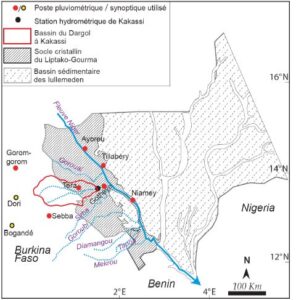
RESUME : Plusieurs travaux ont récemment mis en évidence une hausse des écoulements des rivières sahéliennes qui s’est produite durant la période des sécheresses. Cette inadéquation (sécheresses et hausse des écoulements) constitue un écueil hydrologique important dont l’origine est liée tantôt au climat, tantôt à l’homme. Ce travail a pour objectif d’appréhender la part respective de l’homme et du climat dans la hausse des écoulements à travers une étude de cas sur le bassin de Dargol, un des principaux affluents sahéliens du fleuve Niger. La corrélation des données pluviométriques et hydrométriques des 60 dernières années et la dynamique d’occupation des sols du bassin ont permis de dégager, suivant un ordre chronologique, l’influence prépondérante des actions anthropiques et climatiques dans l’augmentation des écoulements. La tendance à la hausse a connu deux ruptures positives intervenues respectivement en 1985 et 1995. Entre ces deux dates, les écoulements ont augmenté de 95 % par rapport à ceux d’avant 1985. Cette hausse, observée durant les sécheresses, coïncide avec une forte tendance à l’augmentation des surfaces nues encroûtées et à la baisse du couvert végétal liée aux actions anthropiques sur le bassin (mise en culture et déboisement). Après 1995, les écoulements ont de nouveau enregistré une augmentation de l’ordre de 75 % par rapport à ceux observés entre 1985 et 1995. Ils sont fortement corrélés à l’amélioration de la pluviosité et à l’intensification de l’agressivité climatique. Ainsi, les hausses sont respectivement liées à l’homme puis au climat.
Mots clés : écoulement, occupation des sols, variabilité climatique, Dargol, Niger.
ABSTRACT:
Rise of flows on the Dargol catchment: between human and climatic factors
Recent works highlighted an increase in stream flows of Sahelian rivers during the dry period 1968-1995. This inconsistance (drought and increase in runoff) constitutes a main scientific challenge; it originates from Human and Climatic factors. This paper aims to propose to determine the respective part of Human and Climatic factors in the increase in runoff; this will carried out through the Dargol river basin, one of the main Sahelian tributaries of Niger River. The statistical analysis of hydrometric and rainfall data in the last 60 years and the land use evolution in the basin allowed us to determine a time evolution with firstly human factors and then natural ones (climatic) to explain the increase in discharges. The increasing trend showed two positive breaks respectively in 1985 and 1995. During the 1985-1995 period, stream flows increased in 95% compared with the previous period (1957-1984). This rise, observed during the dry period that suffered West Africa after 1967, is consistent with a large increase in bare and crusted soils areas and the reduction of vegetation cover linked with human actions in the Dargol basin (extension of cropping, deforestation), and thus can be correlated with the basin anthropisation. After 1995, discharges strongly increased again, in 75% compared to the 1985-1995 period, being then correlated with the rise in rainfall and climate aggressiveness intensification. It can be summarized the increase in stream flows is respectively linked to human activities, and then to climate evolution.
Key Words: runoff, land use, climatic variability, Dargol, Niger.